




How to Print on Greaseproof Paper: The Complete Guide for Food Businesses
Are you a business looking for packaging that stands out, uses recyclable materials where possible, and never lets your presentation drop? Then you should consider custom-designed greaseproof paper.
This can be an extremely high-impact and cost-effective way to get noticed. However, to achieve the best results, it is important to choose the right print method.
That said, for those who don’t know how to print on greaseproof paper, it can be difficult to know what to do or even look for in a printing company. Which is exactly why we’ve written this guide to explain the process.
Can You Print on Greaseproof Paper at Home?
One of the first things businesses ask is whether it is possible to print on greaseproof paper in the office using an inkjet printer. Well, in theory, it is possible, but the results can be mixed. This is because, while standard printers can feed individual sheets, the low absorbency of greaseproof paper often results in inconsistent print quality and smudging. Additionally, as home inks are not food-safe, they are unsuitable for direct food contact.
Overall, DIY printing is best kept to crafts, gift wrapping, or decorative projects. However, for food businesses, custom-printed greaseproof paper is best produced for you by professional printers.
What Print Methods Are Used for Commercial Greaseproof Paper?
For those wanting commercial greaseproof paper, various specialist printing methods are used to deliver a consistent quality and meet food-contact requirements.
Typically, for large volumes, flexographic printing is the most common option. It is known for producing sharp logos and design reproductions with excellent colour consistency.
Digital printing is also popular. It suits shorter runs. Offers more colour options. And handles detailed artwork extremely well. Additionally, screen printing is occasionally used for simple graphics. But offset printing is generally unsuitable for grease-proof paper.
Star Stuff uses all of these print methods as required, with food-safe inks. Please contact our friendly team for more information on minimum print runs and turnaround times.
Food-Safe Inks: Why They Matter and What to Look For
When greaseproof paper comes into direct contact with food, the inks used become just as important as the paper itself. Both are critical compliance requirements that must be met.
Food-safe inks are formulated without harmful solvents or heavy metals and are made to minimise migration into food. In Australia, water-based inks are generally preferred because they comply with food-contact material regulations. Especially those referenced by FSANZ.
If oil-based or UV-cured inks are used, you are advised to ask your supplier for a food safety declaration. This will verify that they meet food-contact migration limits.
At Star Stuff Group, we only use food-safe inks. We are also happy to provide a compliance declaration if required.
Designing for Greaseproof Paper: What Works and What Doesn’t
Designing for greaseproof paper can be tricky. But the key to doing it successfully is to understand how it behaves.
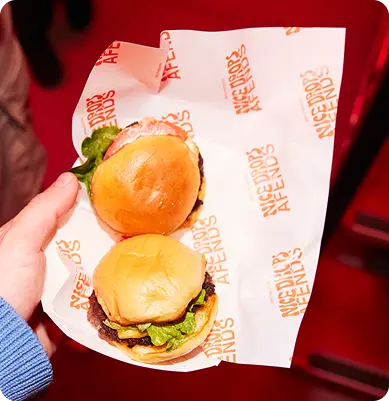
As greaseproof paper is both semi-translucent and lightly coated, using very light shades on it can lose impact. By contrast, dark, bold colours create the strongest visual image. Step-and-repeat logo patterns are also a versatile and cost-effective option. In particular, for food packaging, bakery boxes, tray liners, wrapping sandwiches, burgers, chips, cakes, and pastries.
When creating your design, it is recommended to keep the text at 8-10 points or larger. At the same time, avoid using thin fonts or complex logos. You should be mindful that full ink coverage may increase show-through on lighter-weight stock. Hence, leaving some unprinted space often creates a cleaner result.
To achieve the best print quality, supply your printer with vector files in AI, EPS or PDF format. Be sure, confirm whether your supplier requires CMYK or Pantone colours, and always test a proof before approving production. Even making a small tweak at the proof stage can make a big difference to the finished packaging and really help your brand to pop.
What to Expect from a Professional Print Run
Depending on the printing method used and the nature of your job, minimum order quantities might apply. Our team will advise you accordingly. But digital jobs may start at around 500 sheets, while flexographic runs usually require larger volumes.
Generally speaking, you should allow around 10 to 20 business days for printing after the artwork has been approved. However, faster services may be available if required.
Once printing is complete, you can request a digital or physical proof to ensure the colours and size meet your expectations. This is recommended as greaseproof stock can reproduce colour differently from standard coated papers.
The team at Star Stuff Group can provide you with more information on actual minimum order quantities, lead times, and the proof process.
Sheet Sizes Available for Custom Printed Greaseproof Paper
It is important to select the right custom sizes because this helps to reduce waste and keep food fresh.
Typically, full sheets measure 660 x 400 mm, which is the standard size for hospitality. This fits most serving trays, boards, and baskets. Half sheets suit sandwiches measure 330 x 400 mm and are generally used for takeaway bags, smaller trays and burger wraps.
Another option is quarter sheets, measuring 330 x 200 mm. They are regularly used in small serving baskets, chip cones, and individual servings. Additionally, rolls are available for continuous-wrapping applications, and custom-cut formats can be produced to meet your packaging requirements.
How to Choose a Greaseproof Paper Printer in Australia
When comparing suppliers in Australia, it is natural to focus on price. However, arguably even more important is confirming that the company specialise in food packaging, uses food-safe inks, and can provide you with compliance documents if required.
Don’t be afraid to ask for previous examples of their work to ascertain the quality of the product you will get. It is also a good idea to discuss minimum orders, reorder pricing, paper thickness, labels, and lead times. There is no harm, too, in checking whether they offer samples before committing your money.
Star Stuff Group will happily entertain all these requests and enquiries. We are an experienced local team that specialises in creating custom printed greaseproof paper that strengthens your brand.
Frequently Asked Questions

In theory, a laser printer can print on greaseproof paper. But it is not ideal because heat may damage the uncoated surface. Additionally, it can affect moisture resistance, and the toner may not be compatible with food-contact industry standards.
The number of colours that can be printed on greaseproof paper depends on the type of printing method you use. Generally speaking, flexographic printing can manage up to six spot colours. However, digital printing can accommodate more detailed designs that really elevate your packaging game and attract customers.
It can potentially do so, albeit only slightly, in heavily printed areas. However, high-quality printing is known to maintain grease resistance. This makes the paper perfect for restaurants, serving on a plate, and food packaging sets. Just to be sure, it might be a good idea to request samples and a few tips before ordering.